
Most people meet this word on the worst day of their life. A parent has died, someone calls the bank, and a voice on the other end says the account is frozen until probate. So you go looking for an answer to a question you never expected to ask: what is probate, and how long will this take?
It feels like a crisis dropped on top of a loss. It is not. Probate is a process, with steps and a timeline. Here is the plain English version of what your family is walking into in Connecticut.
What Is Probate?
Probate is the court-supervised process of settling what someone owned after they die. The court confirms who has authority to act, makes sure debts and taxes get paid, then approves passing the rest to the people who inherit it. Confirm, pay, distribute.
It is also public. The filings become court record, so the will, the asset inventory, and who receives what are open for anyone to look at.
And here is the misconception we correct almost every week. Having a will does not avoid probate. A will is the instruction manual for probate, not a way around it. It names who is in charge and who inherits. The court still runs the process.
How the Connecticut Probate Process Works
Connecticut does this differently than most states. Rather than county courts, Connecticut runs its own probate system across 54 regional districts, each serving one or more towns. Your case is genuinely local.
Filing With the Probate Court Within 30 Days
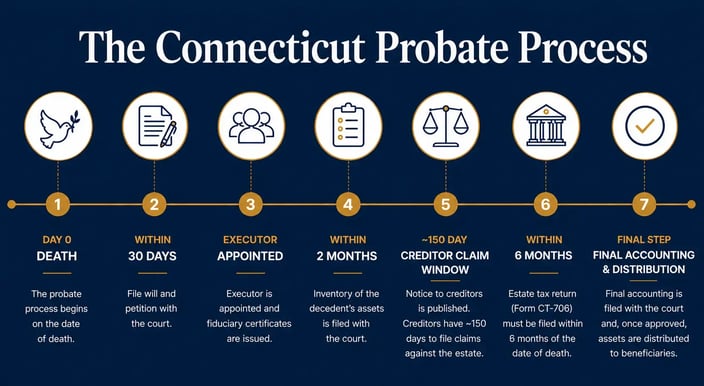
Start here, because this deadline catches families off guard. Connecticut law requires the original will be delivered to the court, and the named executor apply for probate, within thirty days of the date of death. That window opens while you are still writing the obituary. Missing it without legal justification is an infraction carrying a fine of up to $250.
Filing goes to the district where the person was living at death, not where the family lives and not where the house is. The wrong district costs weeks.
The Court Appoints the Executor and Issues Authority
Being named executor in a will does not make you the executor. The court has to formally appoint you. It then issues fiduciary certificates, the document proving you have legal authority to act. That is the piece of paper that unfreezes things: banks, brokerages, and insurers will not release a dollar without one. Get it in your hands early.
Inventory and Value the Estate
Next you list what the person owned individually: real estate, accounts, vehicles, personal property, business interests. Connecticut requires a formal inventory filed with the court, due within two months of your appointment, using fair market values as of the date of death. Those values drive the tax filings and the court's fee, so get them right the first time.
Notify Creditors and Settle Debts
The court orders notice to creditors, usually published in a local newspaper. Creditors then have a statutory window, generally at least 150 days from publication, to submit written claims. Valid claims get paid in statutory priority: funeral expenses, administration costs, taxes, medical bills.
Debts, taxes, and administration costs are paid before anyone inherits. This is where executors get in trouble. Handing money to beneficiaries before the claim window closes is how a well-meaning executor ends up personally on the hook.
File Final Tax Returns
Three returns are usually on the table: the final personal income tax return, an estate income tax return if the estate earned income, and the Connecticut estate tax filing.
That last one surprises people. Every Connecticut estate files a state estate tax return, even when no tax is owed. Estates under the exemption file Form CT-706NT with the local probate court; taxable estates file Form CT-706/709 with the Department of Revenue Services. The exemption tracks the federal threshold, $15 million for 2026 deaths, so most families owe nothing. You still file, because the court needs it to release the state tax lien on real property.
Final Accounting and Distribution
The executor submits an accounting showing what came in, what went out, and what goes to whom. After review and a hearing or waivers, the court issues a final decree approving distribution and discharging the executor from further liability. What is left passes under the will, or under Connecticut intestacy law if there was none, and the estate is formally closed.
How Long Does Probate Take in Connecticut?
For a straightforward estate, plan on roughly 9 to 12 months.
That number frustrates people, so it helps to know what is eating the time. The creditor claim period runs months and cannot be shortened, the estate tax filing is due at nine months, and the court needs time to review the accounting. Even a simple estate has floors built in.
What pushes an estate past a year:
- Real estate that has to be sold. The estate stays open until it closes.
- A business interest that needs valuing, and often selling.
- A will contest or a fight among beneficiaries. This is the big one.
- Estate tax complexity on a larger estate.
- Slow paperwork. Missing statements and unreturned calls add months quietly.
Connecticut expects a status update if the estate is still open 15 months after appointment.
What Assets Go Through Probate in Connecticut?
It comes down to how the asset was titled and whether a living beneficiary was named.
Goes through probate:
- Real estate titled in the person's name alone
- Bank and investment accounts in their name only, with no beneficiary
- Vehicles titled solely to them
- Personal property: furniture, jewelry, collections, household goods
- Tenants-in-common interests and individually held business interests
Does not go through probate:
- Assets held in a revocable living trust or irrevocable trust
- Accounts with a payable-on-death or transfer-on-death beneficiary
- Retirement accounts with a living named beneficiary
- Life insurance payable to a named person
- Property owned jointly with right of survivorship
One Connecticut wrinkle. Avoiding probate doesn't mean avoiding the court's statutory fee, which is calculated on your gross taxable estate. Even for non-probate real estate—like property held in a trust or with survivorship rights—automatic probate liens prevent a sale until the CT Estate Tax Return is filed and the fee is paid. Only after the court issues a lien release to record on town land records is the property clear to sell.
Does Every Connecticut Estate Have to Go Through Probate?
No. Connecticut has a simplified path for small estates. An estate qualifies for a small estate affidavit (Form PC-212) only if it clears two bars at once under C.G.S. § 45a-273: solely owned personal property of $40,000 or less, and no solely owned Connecticut real estate. Both, not either. A modest estate with a house in the deceased's name alone is disqualified no matter how small the bank balance.
Assets already passing outside probate, like survivorship accounts and trust property, are not counted toward the $40,000 cap. A Connecticut estate tax return may still be required even when full probate is not.
What Happens If There Is No Will?
The estate still goes through probate. What changes is who decides. Connecticut intestacy law sets who inherits, in a fixed statutory order, regardless of what your loved one would have wanted. The court also appoints an administrator rather than an executor, and it may not be the person you would have picked.
Can You Keep Your Family Out of Probate?
Yes, with planning done ahead of time. Trusts, beneficiary designations, and how property is titled are the main tools, and together they can move most or all of an estate out of the court process. That is a full conversation of its own, and we have written it out step by step. Start with our guide on how to avoid probate in Connecticut.

Frequently Asked Questions About Probate in Connecticut
You Do Not Have to Figure This Out Alone
If you are reading this because someone you love died, we are sorry. The 30-day deadline is real, and it landed on you at the worst possible time.
Here is the good news. This is routine for us. We walk Connecticut families through it from first filing to final decree, in plain English, so you always know where you stand. You do not need the paperwork organized before you call. Just reach out and we will take it from there.