
You keep hearing that you "should probably have a trust." But should you, really? Or is it just one more thing an attorney wants to sell you?
Fair question. Estate planning is full of advice that sounds important and explains nothing. You are left guessing whether a revocable trust is worth the effort or whether your will alone is fine.
Here is a straight answer. A revocable living trust offers real, specific advantages for Connecticut families, and it also has honest limits you deserve to know about. This guide covers both, so you can decide with confidence instead of guesswork. The short version of the benefits of a revocable trust: it keeps your family out of probate, keeps your affairs private, and keeps you protected if you ever can't manage things yourself.
What Is a Revocable Living Trust? (The Quick Version)
A revocable living trust is a legal arrangement that holds your assets while you keep full control of them. You are usually all three key roles at once: the person who creates it, the trustee who manages it, and the beneficiary who enjoys it during your lifetime.
"Revocable" is the key word. You can change it, add to it, or tear it up entirely, anytime you are mentally competent. Nothing is locked away from you.
One thing to know up front: a trust only protects the assets you actually transfer into it, a step called funding. You can learn exactly how to fund a revocable trust in our companion guide. For now, let's look at why families set one up in the first place.
Key Benefits of a Revocable Trust
It Avoids Probate
This is the headline benefit. Assets held in a properly funded trust pass directly to your beneficiaries without going through probate court.
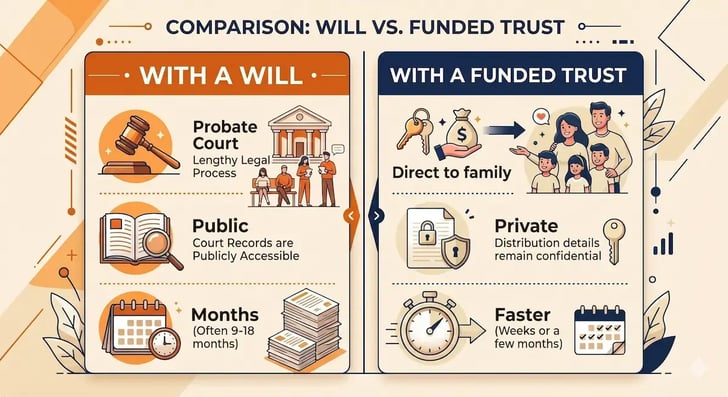
Why does that matter in Connecticut? Probate takes time, it is public, and it can be a burden on your family at the worst moment. One important distinction: a trust avoids the probate process, not the probate fee. Connecticut's statutory probate fee under Connecticut General Statutes Section 45a-107 is graduated, capped at $40,000, and calculated on the value of your estate whether or not those assets pass through a trust. What a trust does is spare your family the delay, the public record, and the procedural grind of the court process. It is one of the cleanest ways to avoid probate in Connecticut and keep things moving. It also avoids a second, separate probate in another state if you own a vacation home there.
It Keeps Your Affairs Private
When a will goes through probate, it becomes a public record. Anyone can see what you owned and who got it.
A trust is private. Its terms stay between you and the people you choose. For families who value discretion, especially here in Fairfield County, that privacy is often reason enough on its own.
It Protects You If You Become Incapacitated
This is the benefit most people overlook, and it may be the most important. If illness or injury ever leaves you unable to manage your finances, your named successor trustee can step in immediately, with no court involvement.
Without a trust, your family might have to ask a court to appoint a conservator, a process that is slow, public, and stressful at the worst possible time. A trust quietly avoids all of that.
It Can Protect Your Loved Ones' Inheritance
A trust does not just hand everything over at once. You can set conditions: release funds at certain ages, earmark money for education, or provide for a blended family in a structured way.
Here is a benefit most people, and most trusts, miss. Many trusts are written to distribute to beneficiaries "outright and free of trust." That hands your loved one a check, and once it is in their hands it is exposed to their divorce, a lawsuit, a creditor, or a future nursing-home bill. We draft ours differently. Each beneficiary's share passes into a separate subtrust created for their benefit. They do not own their inheritance — their subtrust does. That structure keeps what you leave behind shielded from a beneficiary's divorce, lawsuit, creditors, and Medicaid spend-down, so it stays in the family. It is a way to keep having your family's back even after you are gone.
It Keeps Things Moving for Your Family
Because there is no probate to wait on, a successor trustee can manage and distribute assets quickly. Your family gets continuity and clarity during a hard time, not a court calendar.
Revocable Trust vs. Will
A will and a trust do different jobs, and many families use both.
- A will only takes effect after you die, goes through probate, becomes public, and is where you name guardians for minor children.
- A trust works immediately, avoids probate, stays private, and protects you during incapacity.
The common recommendation is to pair them, using a "pour-over will" as a backup that catches anything left outside the trust. We compare them in detail in our guide to the difference between a will and a trust, and you can learn more on our Connecticut wills page.
Revocable vs. Irrevocable Trust: Which Benefits Apply?
Here is where being honest matters. A revocable trust gives you control and flexibility, but that control comes with a trade-off.
- A revocable trust keeps you in charge. You can change it anytime. But because you still control the assets, it does not shield your own assets from your creditors while you are alive, does not protect them from your nursing-home costs, and does not reduce your estate tax.
- An irrevocable trust asks you to give up control. In exchange, it can offer asset protection, Medicaid planning, and estate-tax benefits.
Neither is "better." They solve different problems. If protecting assets from long-term care costs is your goal, our Connecticut irrevocable trust page is the better starting point.
What a Revocable Trust Does NOT Do
A good advisor tells you the limits, not just the perks. A revocable trust does not:
- Save you income tax. While you are alive, it is a "grantor trust," meaning it is tax-neutral. Its income is reported on your personal return under your own Social Security number. There is no special tax break.
- Protect your own assets during your lifetime. Because you keep control while you are alive, the law still treats those assets as yours and within reach of your creditors. (Protecting your beneficiaries' inheritance after you are gone is different: a well-drafted trust can do that, as covered above.)
- Reduce estate tax on its own. For 2026, Connecticut's estate tax exemption is $15,000,000 with a flat 12% rate and no portability between spouses, and Connecticut also has its own gift tax. New York's exemption is much lower at $7,350,000, with a steep "cliff" for estates that go over. A revocable trust does not change any of those numbers.
- Work without funding. An unfunded trust protects nothing. The effort of transferring assets in is the real "cost" of a trust.
If estate tax is a concern for your family, that is a planning conversation worth having, and one our Connecticut estate planning team handles regularly.
Who Needs a Revocable Trust in Connecticut?
A revocable trust is a strong fit if you:
- Own a home, especially if you also own property in another state.
- Have a blended family or want to set conditions on inheritances.
- Value privacy and want to keep your estate out of the public record.
- Want a plan for incapacity, not just for death.
- Want to spare your family the time and cost of Connecticut probate.
It may be less essential if your estate is small and simple and already passes cleanly through beneficiary designations and joint ownership. The honest answer is that it depends on your situation, which is exactly what a consultation is for. Families with assets on both sides of the Connecticut-New York line especially benefit from an attorney licensed in both states.
Frequently Asked Questions
Not sure if a revocable trust is right for your family?
You should not have to guess. The right tool depends on your home, your family, and your goals, and sometimes the answer is a revocable trust, sometimes an irrevocable one, and sometimes both.
We will walk you through it in plain English, with no pressure and no jargon. Schedule your free consultation with Inner Circle Legal Planning. With offices in Milford and North Haven and licensing in both Connecticut and New York, we will help you protect the people in your inner circle with confidence.