
You have been meaning to make a will for years. Maybe you bought the house, had the kids, watched a parent's estate get tangled up, and told yourself you would get to it. If you are finally ready to learn how to make a will, you are doing one of the most caring things you can for the people in your inner circle.
Here is the part most people do not realize. In Connecticut you are absolutely allowed to write your own will without a lawyer. The hard part is not creating a document. The hard part is creating one that actually works when your family needs it, and a will can be perfectly legal on paper and still fail the people you love.
That gap, between a valid document and a plan that truly protects, is where DIY wills quietly fall apart. This is a plain-English guide to your options, what Connecticut law requires, and where to be careful, so you can make a choice with confidence instead of guesswork.
What Connecticut Law Requires for a Valid Will
Before you weigh your options, it helps to know the rules. Connecticut keeps the bar for a valid will refreshingly simple, and the state spells it out in Chapter 802a of the Connecticut General Statutes. To be valid, your will must meet four basic conditions:
- You must be at least 18 years old and of sound mind.
- The will must be in writing. Connecticut does not recognize purely spoken (nuncupative) wills.
- You must sign it at the end, or direct someone to sign your name in your conscious presence.
- Two witnesses must sign the document in your physical presence.
A few Connecticut-specific traps are worth flagging right now. The state does not recognize handwritten (holographic) wills that lack witnesses, and it does not currently accept electronic wills or remote, video witnessing. The witnesses have to be in the room with you.
This matters more if your life crosses the New York border, which is common for Fairfield County families. New York runs a stricter process, including a requirement that both witnesses sign within a 30-day window and that you formally declare the document is your will. New York also passed an Electronic Wills Act that takes effect in late 2027, while Connecticut has no such law. If you own property or have heirs in both states, those differences add up fast.
Meeting these technical requirements is the easy part. The reason DIY wills get into trouble is everything the checklist does not warn you about.
How to Make a Will in Connecticut: Your Options
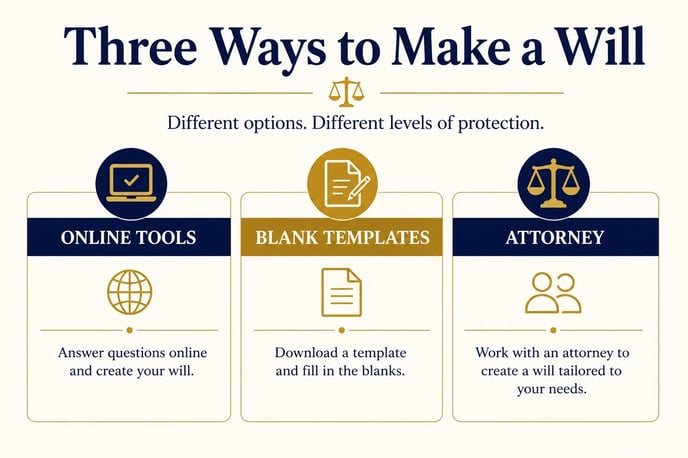
You have three honest paths to a will, and they sit on a spectrum from cheapest to most protective.
- Online will makers and free tools. Platforms like FreeWill, LegalZoom, and Trust & Will walk you through a questionnaire and generate a document. Prices range from free to a few hundred dollars. They are fast and convenient.
- Blank templates and forms. Downloadable will forms or fill-in-the-blank kits. The lowest cost, and the highest risk of vague or conflicting language.
- An estate planning attorney. A lawyer drafts a will tailored to your family, coordinates it with the rest of your plan, and oversees the signing so it is executed correctly.
For a genuinely simple situation, a single person, few assets, no minor children, no real estate, a basic will may be perfectly adequate. There is no shame in starting there.
The catch with the DIY routes is that they hand you a document and leave the rest to you. They generate the paperwork, but you are responsible for the signing, the witnesses, and the notarization, which is exactly where most fatal mistakes happen. They also rarely coordinate your will with the accounts and property that pass outside of it. More on that below.
Where DIY Wills Tend to Go Wrong
Most DIY failures are invisible. The document looks finished, gets tucked in a drawer, and the problem only surfaces years later in probate court, when it is far too late to fix. Here are the five places it happens most.
Execution Errors That Invalidate the Whole Document
A will is only as good as the way it is signed. Missing a witness signature, having a witness sign outside your presence, sloppy notarization, or ambiguous wording can all sink the document. Connecticut probate courts have very little power to overlook a defect in how a will was executed.
When a will is rejected, the state does not guess at your wishes. Your estate passes under Connecticut's default intestacy rules, which may send your assets to people you never intended. One small mistake at the signing table can undo your entire plan.
The Interested-Witness Trap
This one is brutal because it punishes a completely natural instinct. To avoid bothering anyone, DIY testators often ask the obvious people to witness the signing: a spouse or an adult child. In Connecticut, a gift to a witness, or to the spouse of a witness, is automatically voided unless two other disinterested witnesses also signed.
Read that again. If you ask your daughter to witness the will that leaves everything to her, you can accidentally erase her inheritance. The document stays valid, but her gift disappears. No online template stops you from making this mistake.
Assets That Pass Outside the Will Entirely
Here is the misunderstanding that derails more estates than any other: people assume a will controls everything they own. It does not. A will only governs assets held in your sole name with no other instructions attached. Many of your most valuable assets ignore the will completely and pass by their own beneficiary designation:
- Retirement accounts like 401(k)s and IRAs
- Life insurance policies
- Jointly owned property with rights of survivorship
- Transfer-on-death and payable-on-death bank accounts
If your will says "split everything equally among my three children" but your IRA still names only your oldest child as beneficiary, the bank is legally bound to follow the IRA form. The will is powerless to override it. Coordinating these pieces is a core part of real planning, and it is exactly what a checklist of will steps will never tell you. It is also one of the biggest reasons families look into keeping an estate out of probate in the first place.
Guardianship for Minor Children
If you have young kids, your will is the single most important place to name who raises them if you cannot. It is hard to think about, but the alternative is worse: an invalid or missing will hands that decision to a judge who never met your family.
For most parents, this one reason alone justifies getting professional help. A guardianship clause is too important to leave to a form that might not hold up.
What Happens When Life Changes
A will is not a "set it and forget it" document, and Connecticut law will quietly rewrite parts of yours when life shifts. Under state statute, marrying after you sign a will can entitle your new spouse to a share of your estate, having or adopting a child afterward can entitle that child to a share, and a divorce automatically cancels the gifts and roles you assigned to your former spouse.
There is one more trap here. If you try to update a will by scribbling changes in the margin or stapling a note to it, those edits are invalid. A change to a will, called a codicil, has to be signed and witnessed with the same formality as the original. Most people make a will once and never touch it again, which means it slowly drifts out of step with their real life.
Do You Need a Lawyer to Make a Will?
Let's answer the question directly: no, Connecticut does not require you to use a lawyer. You can legally do this yourself.
But that is the wrong question. The real question is not "is my document valid," it is "will my plan actually protect my family." Those are very different bars. A valid will that names the wrong beneficiary form, voids a gift to your kid, or ignores your house is still a failed plan.
Professional guidance earns its keep most clearly when:
- You own real estate, in Connecticut or across the New York line
- You have minor children and need a guardianship plan that holds
- You have a blended family, with stepchildren or children from a prior marriage
- Your estate is large enough to face state estate tax (more on the Connecticut and New York thresholds below)
- You want to avoid probate rather than just survive it
If any of those describe you, the small upfront savings of a DIY will can cost your family far more later. Wondering whether you even need a will or something more is common, and our guide on the difference between a will and a trust is a good next read.
How Much Does a Will Cost in Connecticut?
Cost is usually what pushes people toward DIY, so let's be straight about the real numbers.
The DIY tier looks cheap. FreeWill is free, and paid platforms like LegalZoom and Trust & Will typically run from roughly $99 to several hundred dollars, with trust bundles costing more. Watch for the fine print, though: several services charge auto-renewing subscription fees or a per-edit charge every time you need to change a document, which chips away at the savings over time.
At Inner Circle Legal Planning, our Connecticut wills are part of a transparent, flat-fee package, generally in the range of $1,000 to $2,000, with no surprise subscriptions. A full revocable trust plan runs higher, typically $5,000 to $7,500, because it does far more.
Now weigh that against the back-end cost a DIY mistake invites. Connecticut is one of the few states that charges a probate fee based on your entire taxable estate, not just the assets that go through court, and you can preview the math on the official Connecticut Probate Court fee calculators. On larger estates that fee climbs into the thousands. Paying a bit more now to do it right is often the cheaper choice.
There is also estate tax to consider. For 2026, Connecticut applies a flat 12 percent estate tax above a $15 million exemption, while New York's estate tax kicks in around $7.35 million with a notorious "cliff" that can tax the entire estate if you go just over the line. Neither state lets spouses share their exemptions, so a simple "leave everything to my spouse" will can waste an exemption and trigger a large tax bill at the second death. That is precisely the kind of planning a template cannot do.
 Can You Set Up a Trust Without a Lawyer?
DIY trust kits exist, but a trust is a much heavier lift than a will, and this is where self-service breaks down most often.
The document is only step one. A trust controls only the assets you actually move into it, and that step has a name: funding. If you sign a beautiful revocable living trust and never retitle your home, bank accounts, or investments into it, the trust is empty. When you pass, your estate still marches through the public, months-long probate process you were trying to avoid.
Funding is exactly where most DIY trusts fail, because retitling real estate means preparing and filing new deeds, and most platforms simply hand you the trust and wish you luck. We take a different approach and stay involved through the funding step, preparing the deeds and helping you retitle accounts so the plan works the way it is supposed to. If you want to understand how a trust steers around the courthouse, our guide to the Connecticut probate process lays it out.
What It Looks Like to Work With Inner Circle Legal Planning
Working with an attorney does not have to feel intimidating or expensive-by-the-minute. Our process is built to be calm and clear, in three steps:
- A free strategy session. We start with a no-pressure conversation to understand your family, your assets, and your goals.
- Collaborative design. We build a plan in plain English, not legalese, and walk through every decision together.
- Signing and funding. We make sure everything is executed correctly and, for trust plans, that your assets are actually moved in.
Every plan is a flat-fee bundle, never a meter running and never a forced subscription. A typical will-based plan also includes a durable financial power of attorney, a healthcare proxy, a living will, and HIPAA authorizations, so your family is covered for incapacity, not just inheritance.
One more thing that sets us apart for this corner of Connecticut: our founder, Attorney Bryan Etter, is licensed in both Connecticut and New York. For families with a home here and assets, work, or heirs across the New York line, that means one coordinated plan instead of hiring separate lawyers in two states.
Frequently Asked Questions
Ready to make a will that actually protects your inner circle? The first conversation is free, friendly, and pressure-free. Schedule your free consultation and let's get your family protected with confidence.