
You sat down to protect your family, and now you're stuck on a fork in the road you didn't see coming. You've decided a trust makes sense. Good. But the moment you start reading, everyone keeps talking about a revocable vs irrevocable trust, as if you're supposed to already know which one you need.
It's confusing on purpose, almost. The two trusts sound nearly identical, but they behave in completely different ways, and choosing the wrong one can cost your family control, money, or a missed chance to protect the home you worked your whole life for.
Here's the good news. The core difference is simpler than the legal websites make it sound, and once you understand it, the right path for your family usually becomes clear. This guide breaks it down in plain English, with a focus on what actually matters here in Connecticut and across the New York border, where the tax and Medicaid rules change the answer in ways the big national articles never mention.
The Core Difference Between a Revocable and Irrevocable Trust
The difference comes down to one word: control.
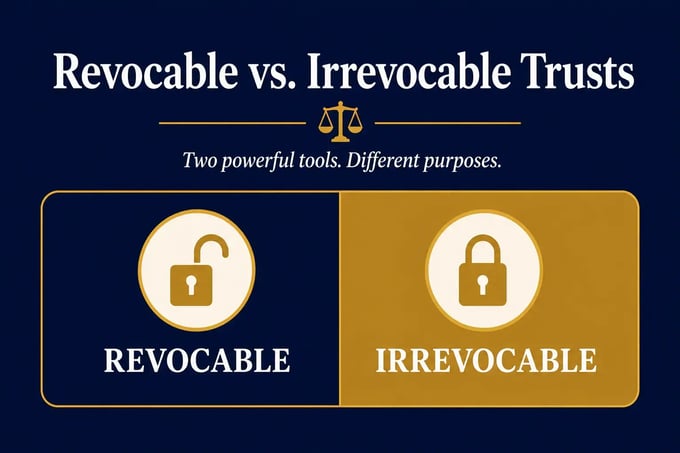
A revocable trust can be changed, updated, or completely undone by you at any time while you're alive. An irrevocable trust generally cannot be touched once it's funded, because you've given up ownership of what's inside it. That single difference in flexibility drives everything else, from your taxes to whether your assets are protected from creditors or a nursing home.
Think of it this way. A revocable trust keeps the steering wheel firmly in your hands. An irrevocable trust hands the keys to a separate driver in exchange for protections you can't get any other way.
How a Revocable Trust Works
What You Can and Cannot Do With a Revocable Trust
A revocable living trust is built for control and continuity. You typically serve as your own trustee, which means you keep managing your assets exactly as you do today. You can add property, take it back out, change your beneficiaries, or dissolve the whole thing on a Tuesday afternoon if you want to.
Because you keep that much control, the IRS treats the trust as tax-transparent. All the income just flows onto your personal Form 1040 under the grantor trust rules, so there's no separate tax headache while you're living.
What a revocable trust does well:
- Avoids probate. Your assets pass to your family privately, without the court process. We walk through this in our guide on how to avoid probate in Connecticut.
- Plans for incapacity. If you can't manage your affairs, your chosen successor trustee steps in instantly. No public conservatorship, no court-appointed stranger.
- Keeps your wishes private. Unlike a will, a trust isn't a public record.
- Protect your loved ones' inheritance. The ability to create divorce, lawsuit & creditor protections over a spouse/child's inheritance is a huge benefit of a trust over a will.
Now the limitation you need to hear clearly. Because you can reach in and reclaim everything at any time, a revocable trust offers zero protection from creditors, lawsuits, or a Medicaid spend-down. The law sees those assets as still fully yours. For a deeper look at how this structure fits a Connecticut family, see our Connecticut revocable living trust page.
Who a Revocable Trust Is Designed For
A revocable trust is the foundation of most modern estate plans. It tends to be the right fit if you:
- Want to keep your assets out of probate and out of the public eye
- Want a seamless plan for incapacity that keeps your family in charge
- Own property in more than one state, where a single trust can spare your family a second, separate probate (a real concern for families with a home in Connecticut and another across the line in New York)
- Are a married couple who needs built-in provisions to preserve a state tax exemption, which we'll get to in a moment
How an Irrevocable Trust Works
What You Give Up and What You Gain
An irrevocable trust asks something real of you. Once you transfer assets into it, you generally can't take them back, and changes usually require beneficiary consent or a court's approval. You're giving up direct control.
In return, you gain protections a revocable trust simply cannot offer. The assets are legally separated from you, which means they're removed from your taxable estate and shielded from your personal creditors and future lawsuits. After the Medicaid lookback period passes, they can also be protected from long-term care costs.
There's one trade-off worth naming honestly, because the national articles often skip it. When assets are removed from your estate, they can lose the step-up in basis that would normally erase capital gains for your heirs. The IRS confirmed this in Revenue Ruling 2023-2. The good part: a well-drafted trust can be designed with a special power that keeps both the asset protection and the step-up in basis. That's exactly the kind of detail you want an attorney handling, not a DIY template. Our Connecticut irrevocable trust page covers this in more depth.
Who an Irrevocable Trust Is Designed For
An irrevocable trust is a specialized tool. It's usually the right fit for families who need:
- Long-term care and Medicaid planning, using a Medicaid Asset Protection Trust to protect the home and savings
- Estate tax relief, especially for families near Connecticut's or New York's state thresholds
- Asset protection for higher-risk professionals, which Connecticut now specifically allows
- Life insurance planning, holding a high-value policy outside the taxable estate
Revocable Trust vs Irrevocable Trust: A Side-by-Side Comparison
Here's the whole thing at a glance.
| What Matters to You | Revocable Trust | Irrevocable Trust |
|---|---|---|
| Can you change it? | Yes, anytime | No, only with consent or court approval |
| Who controls the assets? | You do | A separate trustee |
| Income taxes | Reported on your personal return | Paid by you or the trust, depending on setup |
| Counted in your taxable estate? | Yes | Generally no |
| Protection from creditors and lawsuits | None | Strong |
| Protection from a nursing home spend-down | None | Yes, after the lookback period |
| Avoids probate | Yes | Yes |
| Keeps things private | Yes | Yes |
Connecticut and New York: Why State Rules Change the Answer
This is where the big national guides leave you on your own, and where the right answer for your family actually lives.
The 2026 federal estate and gift tax exemption is now set at $15 million per individual. That sounds like most families are safe, and at the federal level, most are. But your state has its own rules, and they're far less forgiving.
Connecticut matches that $15 million exemption for 2026, with a flat 12% tax above it. Here's the twist most people miss: Connecticut is the only state in the country with its own gift tax, so large lifetime gifts quietly chip away at that exemption.
New York is tougher. The exemption sits at just $7.35 million, and the state enforces a brutal "cliff." If your estate creeps past 105% of that threshold, New York taxes the entire estate, not just the amount over the line. A family that's only slightly over can owe six figures that careful planning would have avoided entirely.
One more catch that affects nearly every married couple: neither Connecticut nor New York lets a surviving spouse inherit the deceased spouse's unused state exemption. Leave everything outright to your spouse, and you can permanently waste one full exemption. The fix is trust planning, often built right into a revocable trust, so both exemptions are used.
Even probate fees behave differently. In Connecticut, probate fees are calculated on your gross taxable estate, including assets in a revocable trust, so a trust avoids the process but not the fee. In New York, a funded revocable trust bypasses Surrogate's Court and its steep executor commissions altogether. If you're weighing the bigger picture, our team also handles Connecticut probate when families need it.

Trusts and Long-Term Care: The Medicaid Question
This is the question we hear most often, usually phrased like this: can a nursing home take my house?
If your house sits in a revocable trust, the honest answer is yes, it's exposed. Because you still control those assets, Medicaid counts them as fully available, and they'll need to be spent down before benefits kick in. In Connecticut, the Title 19 asset limit for a single applicant is just $1,600, so "spend down" means almost everything.
The tool that actually protects the home is an irrevocable Medicaid Asset Protection Trust. Once assets are placed inside and the five-year lookback period passes, they're shielded from the spend-down.
Now, the part that makes this less frightening than it sounds. A well-drafted Medicaid trust can be built with "retained control" features, so giving up ownership doesn't mean giving up your life:
- You keep the right to live in your home for the rest of your life.
- You can keep receiving income the trust generates.
- You keep the right to change who ultimately inherits.
One note for families with New York ties: New York's planned 30-month lookback for home-care Medicaid has been repeatedly delayed, which currently creates a real planning window. These rules move, so timing matters.
Can You Have Both a Revocable and an Irrevocable Trust?
Yes. And honestly, many Connecticut families use both, which reframes the whole "versus" question.
A common setup looks like this. A revocable trust holds the bulk of the estate, giving you control, probate avoidance, and privacy. Alongside it, an irrevocable Medicaid Asset Protection Trust holds the family home, locking in long-term care protection.
The two structures aren't rivals. They're teammates. The real question usually isn't "which one," it's "what combination protects your inner circle best," and that's a conversation worth having with someone who knows both states.
Which Trust Is Right for Your Family?
You can get a strong sense of your direction by answering a few plain questions:
- Want to keep full control of your assets while you're alive? A revocable trust is likely your foundation.
- Worried about long-term care costs or Medicaid eligibility? An irrevocable trust deserves a serious look.
- Concerned about Connecticut's estate tax or New York's exemption cliff? Irrevocable planning may save your family a fortune.
- Want probate avoidance and privacy without giving anything up? A revocable trust checks those boxes.
If you found yourself nodding at more than one, you're in good company. Most families don't fit neatly into a single box, and the smartest move is rarely a self-diagnosis. It's a clear-eyed conversation about your actual goals.
Our goal is clarity, not guesswork. When you're ready, schedule a free consultation and we'll walk through it together.
Frequently Asked Questions
Estate planning is personal, and the right structure depends on your family, your assets, and the states you're tied to. Inner Circle Legal Planning helps Connecticut and New York families choose with confidence. When you're ready, reach out for a free consultation. We'll have your back.

.webp)