
You are caring for an aging parent. Their memory is slipping, the bills are piling up, and you are holding a power of attorney that feels like it should let you fix everything. So you ask the hard question: can a power of attorney change a will? The worry underneath it is real. If the wrong person could rewrite Mom's or Dad's wishes, no family would ever feel safe.
Here is the reassurance you came for. No, a power of attorney cannot create, amend, or revoke someone's will. Writing or changing a will is a deeply personal act that the law does not let you hand off to anyone else, no matter how broad the document looks. Below, we break it down in plain English, cover the one nuance most articles skip, and explain what this means specifically for Connecticut and New York families.
The Short Answer, and the One Exception Most People Miss
A power of attorney lets an agent act for someone during their lifetime. It does not give that agent the power to sign, amend, or revoke the person's will. That rule is absolute under both Connecticut and New York law. Will-making is personal and cannot be delegated.
But here is the nuance almost every quick answer online leaves out. With certain special authorities written into the document, an agent can reshape where the money actually goes, without ever touching the will itself. These are called "hot powers," and we explain exactly how they work further down. It is the difference between changing the will and quietly rerouting the estate around it.
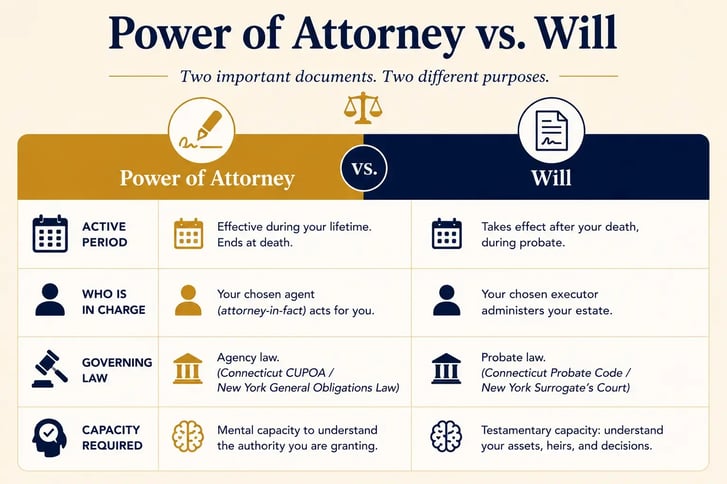
Power of Attorney vs. Will: Two Documents, Two Timelines
The confusion usually comes from treating these as two versions of the same thing. They are not. They live in completely different chapters of your life.
A power of attorney runs on agency law. It lets your chosen agent manage your financial affairs while you are alive, and in Connecticut a power of attorney executed under current law keeps working even if you become incapacitated. A will runs on probate law. It sits completely dormant while you are alive and only takes effect after you pass away and a court admits it to probate.
Two documents, two timelines:
- When it works: A power of attorney is valid only during your lifetime. A will is valid only after death.
- Who is in charge: A power of attorney names an agent (also called an attorney-in-fact). A will names an executor.
- What it takes to sign it: A power of attorney requires the mental capacity to understand the authority you are granting. A will requires "testamentary capacity," meaning you understand your assets and your heirs.
If you want a deeper look at how lifetime documents and after-death documents fit together, our guide to the difference between a will and a trust walks through it step by step.
What a Power of Attorney CAN Do
A well-drafted durable power of attorney is a powerful tool. It typically lets your agent handle the day-to-day financial life you can no longer manage yourself. That usually includes the authority to:
- Run your bank accounts and pay household and medical bills
- Manage investments and retirement accounts
- Collect government benefits like Social Security or Veterans Affairs payments
- Prepare and file your tax returns
- Manage, rent, or sell your real estate
The exact scope depends entirely on what the document says. A power of attorney is only as broad, or as narrow, as it is written to be.
What a Power of Attorney CANNOT Do
Some acts are so personal that the law refuses to let anyone do them on your behalf. No matter how sweeping the document, your agent can never:
- Create, sign, amend, or revoke your will
- Vote in an election for you
- Marry or divorce on your behalf
- Make your healthcare decisions, unless you named that person in a separate healthcare directive or health care proxy
- Make gifts to themselves, unless the document specifically allows it
- Do anything at all after you die
That last point matters more than families expect, and we come back to it below.
The "Hot Powers" Exception: How an Agent Can Reshape an Estate Without Touching the Will
Here is the part that trips people up. An agent cannot change your will, but a modern power of attorney can grant "hot powers" that let the agent change where your assets end up anyway.
Crucially, under the modern statutory forms used in Connecticut and New York, these broad powers are actually included by default. If the boxes or brackets next to these sensitive authorities are left untouched, the agent automatically has the power to act. A principal must specifically initial or check the document to remove or opt out of these authorities. When left active, an agent may be able to:
- Create, amend, or fund a revocable living trust
- Change the beneficiary designations on retirement accounts, annuities, and life insurance policies
- Open joint accounts with rights of survivorship
- Make gifts of your property for asset protection or Medicaid planning
Why does this matter so much? Because assets that pass through a trust or a beneficiary designation skip the will entirely. An agent with these powers could move the bulk of an estate outside probate, leaving the will technically unchanged but practically hollow. This is exactly why these default rules demand an agent you trust completely, and careful drafting. If your plan leans on a revocable living trust or on Medicaid and asset-protection planning, the wording of these powers is not a detail. It is the whole ballgame.
Connecticut's Rules: The Uniform Power of Attorney Act (CUPOA)
Connecticut powers of attorney are governed by the Connecticut Uniform Power of Attorney Act. Any power of attorney signed on or after October 1, 2016 is durable by default, which means it survives your incapacity unless the document says otherwise.
To be valid, the document must be dated, signed, witnessed by two disinterested people, and notarized. That notarization is what makes banks and financial institutions honor it without a fight.
Connecticut also builds in a safeguard for your wishes. Under the state's agent duty rules, an agent generally must try to preserve your known estate plan, unless the document says otherwise. In real life this creates tension. If your agent has to sell a house you specifically left to someone in your will in order to pay for nursing care, they are protected when they act in good faith and in your best interest. And if an agent abuses the role, interested family members can petition the Connecticut Probate Court, where a dishonest agent can be held personally liable.
New York's Rules: General Obligations Law (Title 15)
Because our attorney is licensed in Connecticut and New York, and because so many Fairfield County families own property or have loved ones across the state line, New York's rules matter too.
New York overhauled its power of attorney law effective June 13, 2021. As the New York State Bar Association explains, the reform added a two-witness requirement, replaced rigid "strict adherence" with a more forgiving "substantial conformity" standard, and folded gifting authority directly into the document instead of a separate rider. Unless you change it, the default lets an agent make modest customary gifts up to a set annual limit.
New York also protects families in a way many states do not. Even after a parent dies, a child keeps the right to demand an accounting and challenge an agent's lifetime conduct. New York's highest-level appellate rulings, including a 2025 decision, confirm that death does not wipe out a family's standing to investigate suspicious transfers made while the parent was alive.
What Happens to a Power of Attorney After Death?
This is the point families miss most often. The moment the person passes away, the power of attorney ends. Instantly. The agent's authority is gone, and the bank accounts typically freeze.
At that exact moment, a new person steps in: the executor named in the will. The agent and the executor are two entirely separate roles with separate legal authority, and they are frequently different people. Your lifetime helper does not automatically become your after-death administrator. That handoff is one of the biggest reasons to have both documents in place and coordinated. When the estate does move into probate, an experienced Connecticut probate attorney can guide the executor through it.
What If There's No POA and Someone Loses Capacity? (Conservatorship & Guardianship)
Say your parent never signed a durable power of attorney, and then a stroke or advancing dementia takes their capacity. Now no one has legal authority to act. The family's only option is to go to court.
In Connecticut, that means a conservatorship through the Probate Court. In New York, it means an Article 81 guardianship. Both are slow, public, and expensive, and both put a judge in charge of decisions a simple document could have handled privately.
And here is the crucial part: a conservator or guardian cannot change or write a will either. The United States broadly rejects the idea of a court-created "statutory will," and neither Connecticut nor New York allows one. If your loved one has no valid will when they die, the estate is divided by rigid intestacy formulas, regardless of what everyone knows they actually wanted. The only way to avoid that outcome is to plan before capacity is lost.
Why You Need Both a Will and a Power of Attorney
People often ask which document is more important. The honest answer is that the question is a trap, because each one covers a gap the other cannot.
- A will but no power of attorney. Your after-death wishes are safe, but your lifetime is exposed. If you become incapacitated, your will sits there doing nothing while your family gets locked out of your accounts and forced into a court conservatorship.
- A power of attorney but no will. Your lifetime is covered, but your legacy is left to chance. The power of attorney dies with you, and without a will the state's intestacy rules decide who gets what, which may not match your wishes at all, especially if you want to protect a disabled child, an unmarried partner, or a family business.
A power of attorney protects you while you are alive. A will protects the people you love after you are gone. You need both, and they need to work together. If you have not started yet, our guide on how to make a will is a good first step. And if you want to make sure both documents actually work together, our Connecticut wills service and our attorney's plain-English planning approach are built exactly for that.