The will was read, and it didn't sound like them. Maybe a caregiver who arrived two years ago now inherits the house. Maybe one sibling gets everything and nobody can explain why. If you're trying to work out how to contest a will, you're probably carrying grief and a nagging sense that something went wrong.
Here is the hard part. Connecticut courts don't overturn a will because it feels unfair. And there is a clock, which can start running before most families realize it.
This guide covers what Connecticut courts actually look at, who can challenge a will, the deadlines and the real costs, so you can decide your next step calmly.
What Is a Will Contest?
A will contest is a formal challenge, filed in Connecticut Probate Court, arguing that a will is legally invalid. It is not a request to make the estate fairer. Connecticut strongly protects a person's right to leave their property as they choose. A parent can leave an adult child out, favor one sibling, or give everything to charity.
So these, by themselves, are not grounds for contesting a will:
- The will is unfair, or a sibling received more
- You were verbally promised something that isn't in the will
- You disagree with the choices they made
Who Can Contest a Will in Connecticut?
Under C.G.S. § 45a-186, only an "aggrieved" person may appeal. In plain English, you need a direct financial interest that the will actually reduces.
People who usually have standing:
- Heirs-at-law, such as a spouse, child or sibling, who would inherit under Connecticut's intestacy rules if the will didn't exist
- Beneficiaries under an earlier will whose share the newer will cut or removed
- An executor or trustee named in an earlier will, who has a duty to protect that will's beneficiaries
People who usually don't:
- A friend promised something verbally (at most, they may have a creditor claim against the estate)
- A creditor of one of the heirs
Grounds for Contesting a Will in Connecticut
Only a handful of arguments actually work.
Lack of Testamentary Capacity
Connecticut requires the person making the will to be of sound mind and memory when they sign. The bar is lower than many families expect. They needed to understand what they owned, who their close family were, that the document was a will, and how those pieces fit into a plan.
A dementia diagnosis is not enough on its own. Capacity is measured at the moment of signing, and someone with cognitive decline can still sign a valid will on a clear day. The best evidence is close to that date: medical records, caregiver testimony and the drafting attorney's notes.
Undue Influence
The most common ground, and one of the hardest to prove. It means someone pressured the person so heavily that the will reflects the influencer's wishes, not theirs. Connecticut courts look at four elements:
- Susceptibility: they were vulnerable through illness, age or dependence
- Opportunity: the influencer had close, unmonitored access
- Disposition: the influencer had a motive to exert pressure
- Unnatural result: the will departs sharply from earlier plans, in the influencer's favor
Red flags include isolating the person from family, choosing or paying the drafting lawyer, and being in the room at signing.
The burden can shift. Normally the challenger must prove undue influence. But if the beneficiary held a fiduciary or confidential relationship with the person, such as acting as their power of attorney agent, and benefited substantially, the burden can shift to the beneficiary to prove by clear and convincing evidence that the person acted freely. An ordinary parent-child relationship does not trigger that shift.
Improper Execution
Under C.G.S. § 45a-251, a will must be in writing, signed by the person (or by someone at their direction and in their presence), and witnessed by two people who sign in their presence.
A beneficiary acting as a witness doesn't void the whole will. It voids only that witness's own gift, and even that survives if two other disinterested witnesses signed.
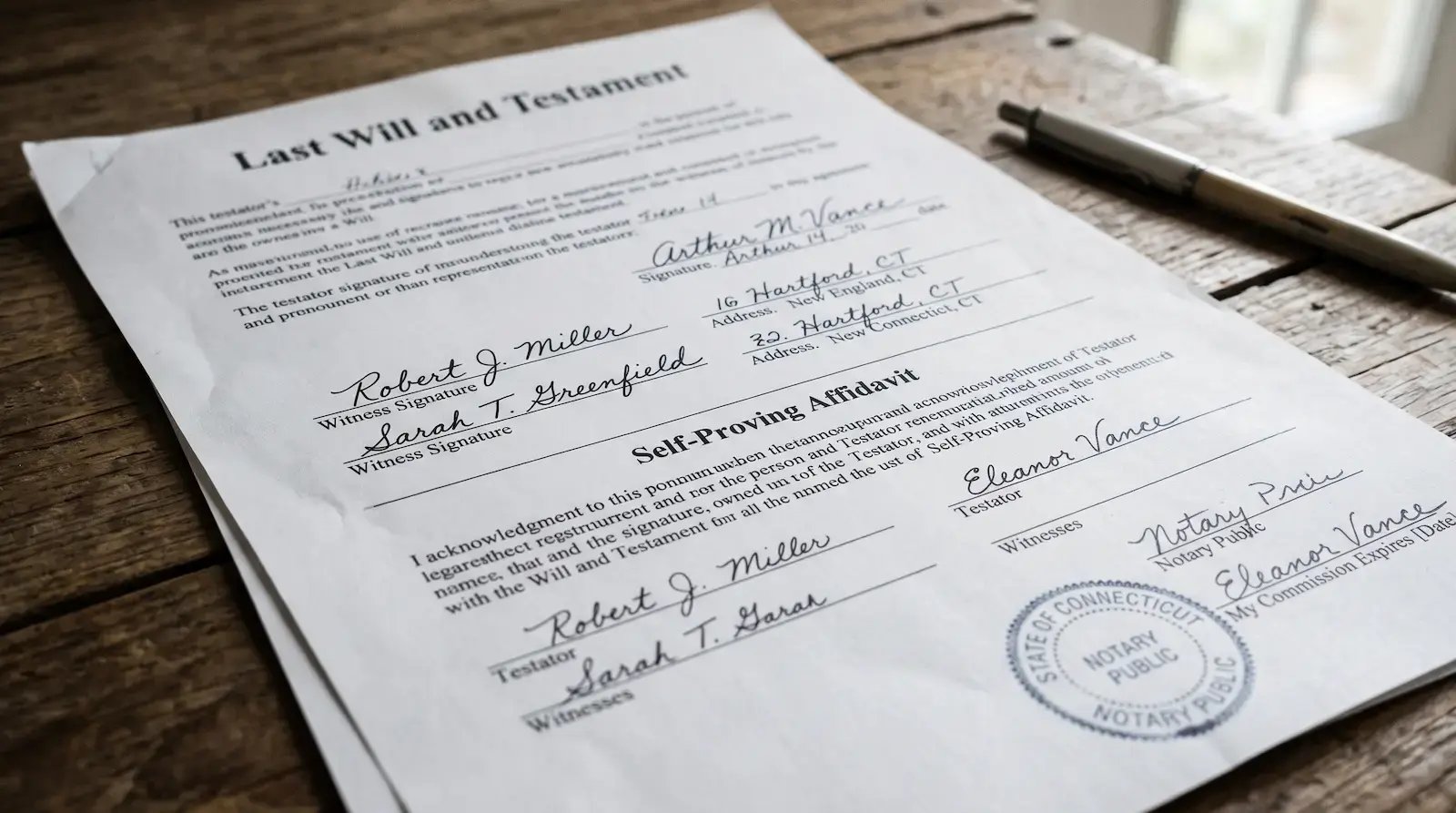
That's why a properly drafted will is hard to attack on technical grounds. Most include a self-proving affidavit under C.G.S. § 45a-285, sworn before a notary when the will is signed.
Fraud or Forgery
Fraud means someone lied to get the will made or changed, either about what was being signed or about the family, such as claiming a child had stolen from them. Forgery means they never signed it. Both are rare and usually need expert evidence.
A Later Will or Codicil
Sometimes the will isn't invalid, just out of date. Under C.G.S. § 45a-257, a later valid will or codicil can revoke an earlier one. If a newer document surfaces, § 45a-295 lets the Probate Court set aside a decree admitting the older will.
How to Contest a Will in Connecticut, Step by Step
Here is how to contest a will in practice. (For background, see how probate works in Connecticut.)
- Don't sign the waiver. The probate petition (Form PC-200) may come with a waiver of notice. Hold off signing until you've had advice.
- Get the facts reviewed early. Gather earlier wills, medical history around the signing date, and who was involved.
- File a written objection. File it in the Probate Court where the person lived, before or at the hearing.
- Discovery and hearing. Records, depositions, then a hearing with witnesses and experts.
- The decree. The court admits or rejects the will.
- Appeal if needed. Either side can appeal to Superior Court, on a short deadline.
A Connecticut probate attorney can tell you whether your facts fit before you spend money on steps 3 to 6.
How Long Do You Have to Contest a Will in Connecticut?
- 30 days to appeal. Under C.G.S. § 45a-186(b), an appeal to the Superior Court generally must be filed within 30 days. The clock starts on the date the Probate Court sent the decree, not the date you received or read it.
- Asking for reconsideration doesn't reliably stop the clock. In Chartier v. Valliere (2025), challengers asked the Probate Court for a further hearing rather than appealing. They waited for a second decree, and the Appellate Court held their appeal was too late.
- 12 months if you got no notice. C.G.S. § 45a-187 allows up to 12 months for someone who received no notice of the hearing and wasn't present.
- Minors get 12 months after turning 18 under § 45a-188.
Stopping a distribution is also far easier than recovering money or a house after the estate has paid out.
What Happens If the Case Goes to Superior Court?
A Connecticut probate appeal is usually a trial de novo: the Superior Court hears the whole case again, with new evidence and experts allowed. The exception is a Probate Court hearing held on the record.
While the contest is pending, distributions are frozen, though the executor keeps managing the estate. Most will contests settle before a verdict, and settlements are approved by the Probate Court.
An Honest Look at the Costs and Risks
Most will contests don't succeed, and they cost in two ways.
The money is lopsided. Under C.G.S. § 45a-294, an executor who defends a will in good faith can have reasonable legal fees and expert costs paid from the estate. The challenger pays their own lawyer and experts out of pocket. A contest that reaches experts and a hearing can run well into five figures, and more at a full Superior Court trial.
The family cost is real too. A contest can permanently change sibling relationships, and that belongs in the decision.
If the Will Has a No-Contest Clause
A no-contest clause (or in terrorem clause) says anyone who challenges the will loses what it leaves them. In Connecticut:
- Generally valid, but read narrowly. Courts enforce them but construe them strictly.
- Good faith and probable cause protect you. Since South Norwalk Trust Co. v. St. John (1917), a clause isn't enforced against a challenge brought in good faith and with probable cause.
- Clauses that violate public policy aren't enforced. In Salce v. Cardello, a beneficiary objected to an executor's errors on the estate tax return. The Appellate Court (2022) refused to enforce the clause on public policy grounds. In 2023 the Connecticut Supreme Court affirmed that decision (SC 20701, 348 Conn. 90).
If you're also a beneficiary, the clause changes your risk. Have it read before you file anything.
When to Call a Will Contest Lawyer
Talk to a will contest lawyer sooner rather than later if:
- The will changed late in life to favor a caregiver, new partner or one child
- The person was isolated, declining or heavily dependent when they signed
- The will was a do-it-yourself document or the signing seemed irregular
- You're the executor and someone is threatening to challenge the will
- The Probate Court has issued a decree and the 30 days are running
If the dispute is over a trust rather than a will, see how a trust litigation attorney can help.
A conversation isn't a lawsuit. Bryan Etter will look at what you have and tell you plainly whether there's a real case, what it might cost, and what your deadlines are. The first consultation is free, with no pressure.
A Note for Fairfield County Families with New York Property
Real estate is governed by the state where it sits. If a New York resident dies owning a house in Greenwich or Stamford, the will is probated in New York, then goes through ancillary probate in Connecticut (Form PC-201, under § 45a-287). The reverse needs ancillary letters in New York.
A contest in the home state generally holds up the ancillary transfer. Bryan is licensed in both states, which helps Fairfield County families whose estates straddle the border.
Frequently Asked Questions About Contesting a Will in Connecticut
Get Clear Answers Before the Clock Runs Out
If a loved one's will doesn't add up, you deserve a straight answer. Sometimes the law is on your side. Sometimes a contest would cost more than it could recover. Either way, it's better to know before the 30 days are gone. We'll explain your options in plain English, with no pressure.