
Your will is five years old. Since you signed it, a grandchild arrived, and the friend you named as executor moved to Arizona. The document still has your name on it, but it no longer describes your life. So you start looking for the fix, and you find a word you have probably never used out loud: codicil.
Here is the real question underneath it. Do you amend the will you already have, or do you write a new one? Both are legitimate. One of them is usually the better call, and it may not be the one you expect.
What Is a Codicil?
A codicil is a legal document that changes part of an existing will without replacing it. The word comes from the Latin for "little book," and that is a fair description: a short companion document that rides along with the main one, like a legal postscript.
The will and the codicil are not competing sets of instructions. The probate court reads them together, as one plan. Under the doctrine of republication by codicil, signing a valid codicil that refers to your will effectively re-dates the whole will to the day you sign it.
One point catches people out more than any other. A codicil is not a note in the margin. Not a line crossed out, not a page tucked in the envelope. It has to be signed and witnessed with the same formality as the original will.
What a Codicil Can Change
Most people arrive here with one specific change in mind. A codicil can handle things like:
- Naming a different executor when the person you chose has died, become ill, or moved far away
- Adding or removing a beneficiary, such as a new grandchild or a former in-law
- Adjusting a specific gift, like a dollar amount, a piece of property, or a family heirloom
- Updating a guardian nomination for minor children when your first choice is no longer the right one
- Correcting a name after a marriage, a divorce, or a legal name change
If your situation is on that list and nothing else in the will has drifted, a codicil is a real option. If you nodded at three of them, keep reading. That changes the answer.
 Connecticut Requirements for a Valid Codicil
Connecticut does not treat a codicil as a lesser document. It has to clear the same bar as the will itself. Under C.G.S. § 45a-251, a will or codicil is not valid to pass any property unless it is:
- In writing
- Signed by you, the testator, who must be at least 18 and of sound mind
- Attested by two witnesses, each of them signing in your physical presence
That third requirement is stricter here than in some neighboring states. Your witnesses have to be in the room with you. Connecticut also does not recognize handwritten, unwitnessed codicils made here.
Choose your witnesses carefully. Under C.G.S. § 45a-258, any gift to a subscribing witness, or to that witness's spouse, is void unless the document is properly attested without that signature or the person is already an heir. Ask the beneficiary next door to witness your codicil and you may have just written them out of it.
Notarization is not what makes a codicil valid, but a self-proving affidavit is worth the five minutes. Under C.G.S. § 45a-285, your witnesses swear an affidavit before a notary, and the Probate Court accepts it later as if they had testified in person.
Getting any of this wrong is not a technicality. A codicil that fails these requirements may be void, and a poorly drafted one can cast doubt on the perfectly good will it was meant to improve.
Codicil or a New Will: Which Do You Need?
Here is the honest answer, and it is the same one most estate planning attorneys now give: for most changes, a new will is the cleaner choice, and it usually costs only a little more.
Codicils made sense when wills were typed and re-typing forty pages to change one name was a real burden. That constraint is gone, and the drafting work is nearly identical either way: an attorney preparing a codicil still reviews your assets, confirms capacity, and cross-checks every provision in the original. Same care, same signing ceremony, one extra document to keep track of forever.
When a Codicil Makes Sense
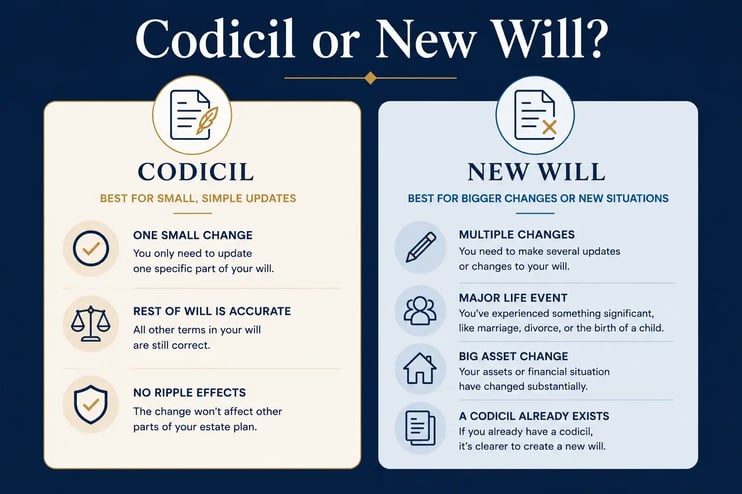
A codicil is a reasonable tool when all three of these are true:
- The change is small and self-contained, like swapping one executor for another
- The rest of the will is still accurate, from the beneficiaries to the residuary clause
- The change does not interact with anything else in the document
It is also useful when time is short. If surgery is scheduled for next week, a narrow codicil beats nothing.
When to Rewrite the Will Instead
Start fresh when:
- You have more than one change to make
- A major life event has happened: marriage, divorce, a death in the family, or a move to Connecticut from another state
- Your assets have changed significantly, especially if the will names specific property you no longer own
- A codicil already exists. Stacking a second one onto the first is where things get genuinely messy
A move deserves its own mention. A will signed in another state is worth a full Connecticut review, not a patch. And a new will revokes everything before it, leaving your family one clean document instead of a paper trail.
The Risks of Relying on Codicils
These are not hypotheticals. They are the ordinary ways codicils go wrong.
Documents get separated. Probate requires the original will and every original codicil. If one is lost, your family is in a lost-document proceeding and your intended change may simply fail. A codicil surfacing after the estate is settled is worse still.
Stacked codicils contradict each other. Amendments written years apart eventually disagree, and an ambiguity a court cannot resolve can cause a gift to lapse entirely.
Codicils hand a will contest its opening argument. Filed alongside the will, a codicil shows anyone whose share was cut the before and the after, side by side, in the public record. That contrast invites a challenge on undue influence or capacity. A new will presents one clean document instead.
Informal amendments are void. Crossing out a name and initialing it does not work. Neither does an unwitnessed handwritten page. Those changes are not weak, they are legally nonexistent.
How This Works With a Trust
If your plan is built on a revocable trust, a codicil is usually not the right instrument at all. Changes are made by trust amendment instead, and the pour-over will rarely needs touching. If you are not sure which kind of plan you have, our guide to the difference between a will and a trust is the place to start.

Frequently Asked Questions About Codicils in Connecticut
Keeping a Good Plan Current
You did the right thing when you signed that will. All that has happened since is life: a wedding, a grandchild, a move, a friend who is no longer the right executor. Keeping a plan current is not starting over. It is maintenance, and a much smaller conversation than the first one was.
We will read what you already have, tell you plainly whether a codicil covers it or a new will is the smarter move, and handle the signing so it holds up when your family needs it to. No pressure, no jargon. Just reach out and bring the document you have.