A life estate splits ownership of a home in two. You (the life tenant) keep the right to live there for the rest of your life, and the person you name (the remainderman) automatically owns it outright the moment you pass away.
That is the short answer to "what is a life estate," and it is usually how the idea arrives. A friend, a realtor or a relative says, "Just put the kids on the deed. It protects the house and skips probate." It sounds simple, sensible and cheap.
Here is the part that rarely gets mentioned. A life estate takes one afternoon to create and can be close to impossible to undo. Once the deed is recorded, your children are not waiting to inherit your home. They already own part of it.
So the real question is not how a life estate works. It is what you give up when you sign one, and whether that trade makes sense for your family. That is what the rest of this guide is about.
Who Owns the Property in a Life Estate?
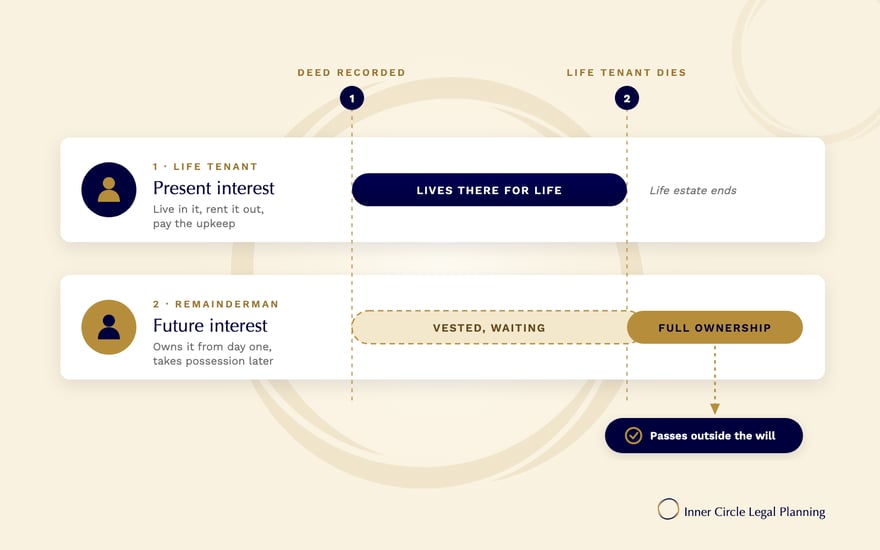
Both of you do, at the same time, in different ways.
- The life tenant owns the present interest. You can live in the home, use it and rent it out for as long as you live.
- The remainderman owns the future interest. They hold the right to full ownership the instant your life estate ends.
Connecticut's Office of Legislative Research puts the key consequence plainly: the life tenant can live in the home or rent it out, but generally cannot sell it without the remainderman's consent. The same is true of a mortgage or a refinance.
That is the single most important fact on this page. Neither of you can sell or borrow against the whole property alone.
It is also worth knowing that the remainderman's interest is not a promise that appears when you die. It is a real, vested property interest from the day the deed is recorded. Your child owns something today, with everything that comes with ownership.
This is very different from a living trust. If you are comparing the two, our guide to who owns the property in a revocable trust explains why the answer there is "you still do."
 How a Life Estate Deed Works in Connecticut
Most life estates are created with a new deed. You deed the home to your children (or whoever you choose) and keep a life estate for yourself, then record the deed with the town clerk in the town where the property sits.
A few filing details come with it:
- Form OP-236. Connecticut's Real Estate Conveyance Tax Return is submitted to the town clerk with the deed. Even when no conveyance tax is owed, the return is still filed, with an exemption code claiming the exemption.
- Gift tax returns. The same instructions warn that transfers for no consideration may be subject to federal or Connecticut gift tax. The interest your children receive is a "future interest," and the IRS says gifts of future interests must be reported on Form 709 regardless of their size. If you file a federal Form 709, Connecticut's instructions say to use it to determine whether you also need to file Form CT-706/709. Filing a return does not necessarily mean tax is due.
Connecticut also creates a kind of life estate without any new deed. When someone dies with a will, their surviving spouse can choose to take a statutory share, which is a life estate in one-third of the property passing under the will, instead of what the will left them. The spouse has to file that election with the Probate Court within 150 days. Most national articles never mention it, but it can reshape an estate plan built around a will alone.
What the Life Tenant Can and Cannot Do
As the life tenant, you can:
- Live in the home for the rest of your life
- Rent it out and keep the rental income
- Continue to treat it as your home day to day
You cannot, without every remainderman signing:
- Sell the property
- Mortgage or refinance it
- Take out a reverse mortgage to pay for care at home
You also take on real responsibilities. The life tenant is responsible for the ownership costs during their lifetime, such as taxes, insurance and upkeep. And Connecticut law says a life tenant who commits "waste," meaning damaging the property or letting it fall into disrepair, is liable to the injured party, unless the deed expressly allowed the acts complained of.
In plain English, your own children could sue you over the condition of your own home. That is the clearest sign this is shared ownership, not a courtesy.
What the Remainderman Receives, and When
When the life tenant dies, the life estate simply ends. Full ownership passes to the remainderman automatically. The home does not pass under your will, and nobody has to be appointed to transfer it. As the next section explains, though, that is not the same as staying out of probate court.
There is often a tax benefit at that point, too. Because the life tenant kept the right to live there, the home is generally included in their estate at death, and federal law gives inherited property a basis equal to its fair market value at the date of death. That "step-up" can sharply reduce capital gains tax if your children later sell. The details depend on your situation, so it is worth confirming with your tax advisor.
Now the risk nobody mentions. Because your child's interest is vested today, it is their asset today. That means their creditors, their divorce or their bankruptcy can reach their share of your home while you are still living in it. You did nothing wrong, and the house is still exposed.
Why Your Life Estate Still Counts for Probate and Medicaid
Many people assume that once the kids are on the deed, the house is off the books. It is not. Both Connecticut's probate system and its Medicaid program treat the life estate you kept as something with real value.
- Probate. Because you kept the right to live there, the home's full value at your death is reported on the Connecticut estate tax return filed with the Probate Court. That value counts toward the estate's probate fees, and your family needs the court's release of lien to give the remaindermen clear title. The house skips your will, but not the probate court.
- Medicaid. Connecticut's Medicaid system also puts a dollar value on the life estate you keep, worked out from your life expectancy and the home's fair market rent. Keeping a life estate means you may have to spend down that value before you qualify for Medicaid (Title 19).
Life Estate Deed vs Irrevocable Trust
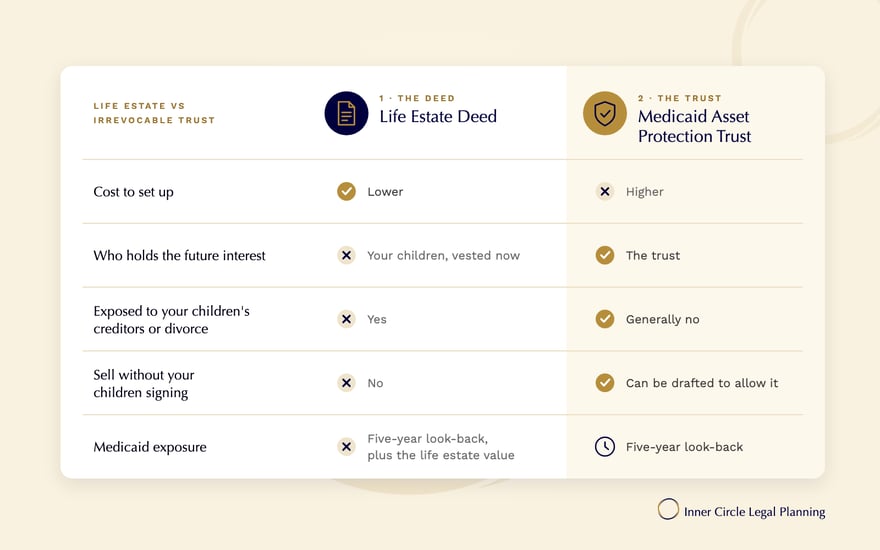
This is the comparison most families actually need. A life estate deed is cheaper and simpler to set up. A Medicaid asset protection trust costs more, but it does more.
With a deed, your children hold a vested interest immediately, with all the creditor and divorce exposure that brings. With a trust, the trust owns the home, not your children, so their personal problems do not attach to it the same way. A trust can also be drafted to keep flexibility a deed simply cannot, such as allowing a sale with the proceeds staying protected, or adjusting who ultimately inherits.
For the full picture, see our pages on the irrevocable trust and the Medicaid asset protection trust.
Where Life Estates Cause Problems
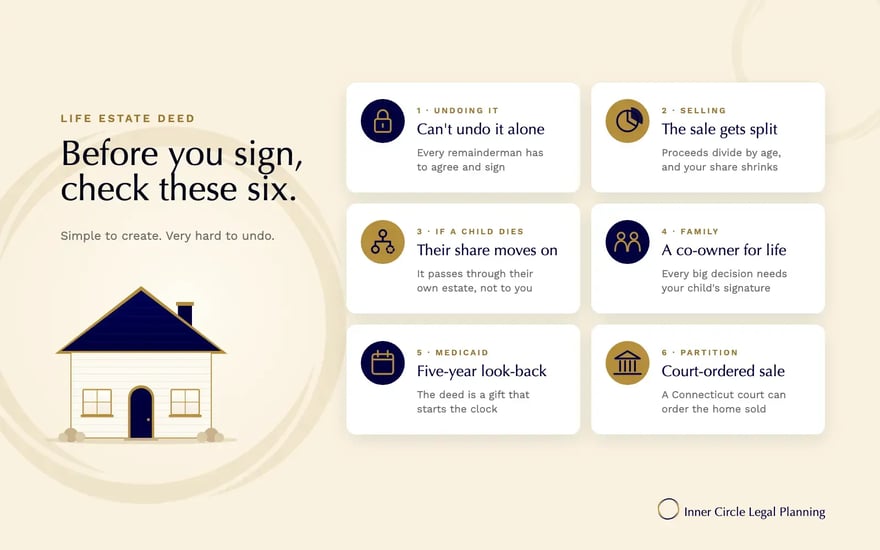
A life estate works best when nothing changes. Life rarely cooperates. These are the situations where families most often get caught out:
- You want to undo it. You cannot cancel a life estate on your own. Every remainderman has to agree and sign, and some will refuse, or be unable to sign because of illness, incapacity or simply being out of reach.
- You need to sell while you are alive. Downsizing, moving closer to family or paying for assisted living all mean selling. The proceeds are split between your life estate and your children's remainder, based on your age at the time. The older you are, the smaller your share. That is rarely what anyone expected.
- A remainderman dies before you. Their interest does not come back to you. It passes through their own estate, which can send part of your home to a spouse or someone else you never intended.
- Family relationships change. A falling out with a child who is now a co-owner of your home is painful in a very particular way. Every major decision about the house still needs their signature.
- Medicaid. Signing the deed is a gift of the remainder interest, and federal law looks back 60 months for gifts like this. If care is needed within five years, a penalty can apply. Even after five years, the deed leaves a new exposure behind: the life estate you keep has its own value, which you may have to spend down before you qualify. A Medicaid asset protection trust is often the better tool for that goal.
- A court can force a sale. Connecticut's partition statute expressly covers land held by a life tenant with a remainder. A court may order the property sold when it will better promote the owners' interests, and that sale binds both the life tenant and the remaindermen. The court then decides how the proceeds are held to protect everyone's interest.
None of these mean a life estate is always wrong. They mean it is a permanent decision that deserves the same care as any other part of your asset protection plan.
Frequently Asked Questions About Life Estates
Talk It Through Before You Sign
A life estate is not a bad tool. For some families, it is exactly right. But it is permanent, it changes who owns your home today, and it ties your future choices to your children's signatures and circumstances.
If someone has suggested putting the kids on the deed, take a breath before you act. A short conversation now can help you choose the option that protects your home and your inner circle, with confidence and in plain English.