
You do. When you ask who owns the property in a revocable trust, the answer is the person who created it: the trust's name goes on the deed, but you keep ownership in every way that matters.
That answer usually arrives at an awkward moment. Your bank, your insurer or the tax assessor sends a letter asking who owns the house now, and you realize you are not sure. You signed the trust, you signed the deed, and somewhere along the way the name on your home changed.
So here is the real question. If you still own it, what did the trust actually do? And what does still owning it mean for your taxes, your creditors and your eligibility for Medicaid?
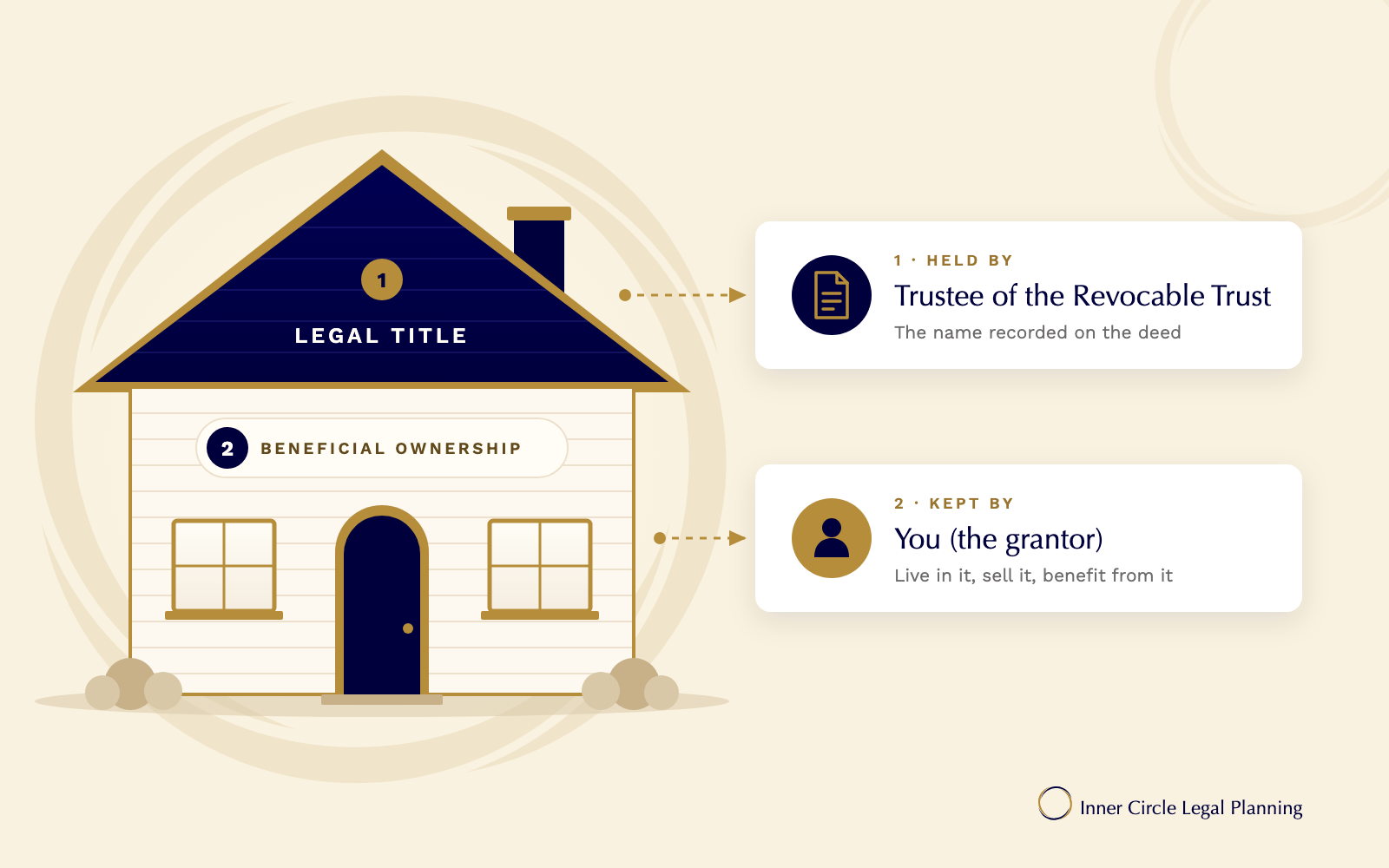
Legal Title and Beneficial Ownership Are Not the Same Thing
Ownership has two layers, and a trust splits them apart.
- Legal title is the name on the record. Once your house goes into a revocable trust, legal title is held by the trustee of the trust.
- Beneficial ownership is the right to use, enjoy and benefit from the property. That stays with you.
Think of it this way. The name on the deed changed. The person who lives there, controls it and benefits from it did not.
That is why you can still sell the house, refinance it, live in it and even take it back out of the trust. Connecticut's trust code says that while a trust is revocable and you have capacity, the trustee's duties are owed exclusively to you and the beneficiaries' rights are subject to your control. Everything else on this page flows from that distinction.
The Three Roles in a Revocable Trust: Grantor, Trustee, Beneficiary
Every trust has three roles:
- Grantor (also called the settlor): the person who creates and funds the trust
- Trustee: the person who manages it
- Beneficiary: the person who receives from it
In most revocable trusts, one person wears all three hats while alive. You create it, you manage it, and you benefit from it. That is precisely why ownership does not meaningfully change.
This triple-hat setup is not a loophole. It is exactly how a revocable trust is designed to work.
Who Is the Beneficiary of a Trust?
The beneficiary is the person or people entitled to receive from the trust, now or later. In a revocable trust, you are usually the primary beneficiary during your lifetime, with your children or others named to inherit afterward.
That gives you two kinds of beneficiary. A current beneficiary can benefit from the trust today. A remainder beneficiary only receives once the current beneficiary's interest ends, typically at death.
Trust vs. Beneficiary: Why the Distinction Matters
The trust is the legal arrangement that holds the property. The beneficiary is a person with rights against it. A beneficiary does not own the trust property. They hold a claim on it.
That difference has teeth. Connecticut law limits when a beneficiary's creditors can reach trust property, but those limits expressly do not protect the creditors of a grantor who is also a beneficiary. That gap is your first hint at why irrevocable trusts exist.
Who Owns the Property in an Irrevocable Trust?
Here the answer flips. In an irrevocable trust, the trust owns the property and the grantor has genuinely given it away.
That is the entire mechanism. The protection an irrevocable trust can offer exists because you surrendered control, not despite it.
If you are weighing the two, our guide to revocable vs. irrevocable trusts lays out the trade-offs.
What Retained Ownership Means in Practice
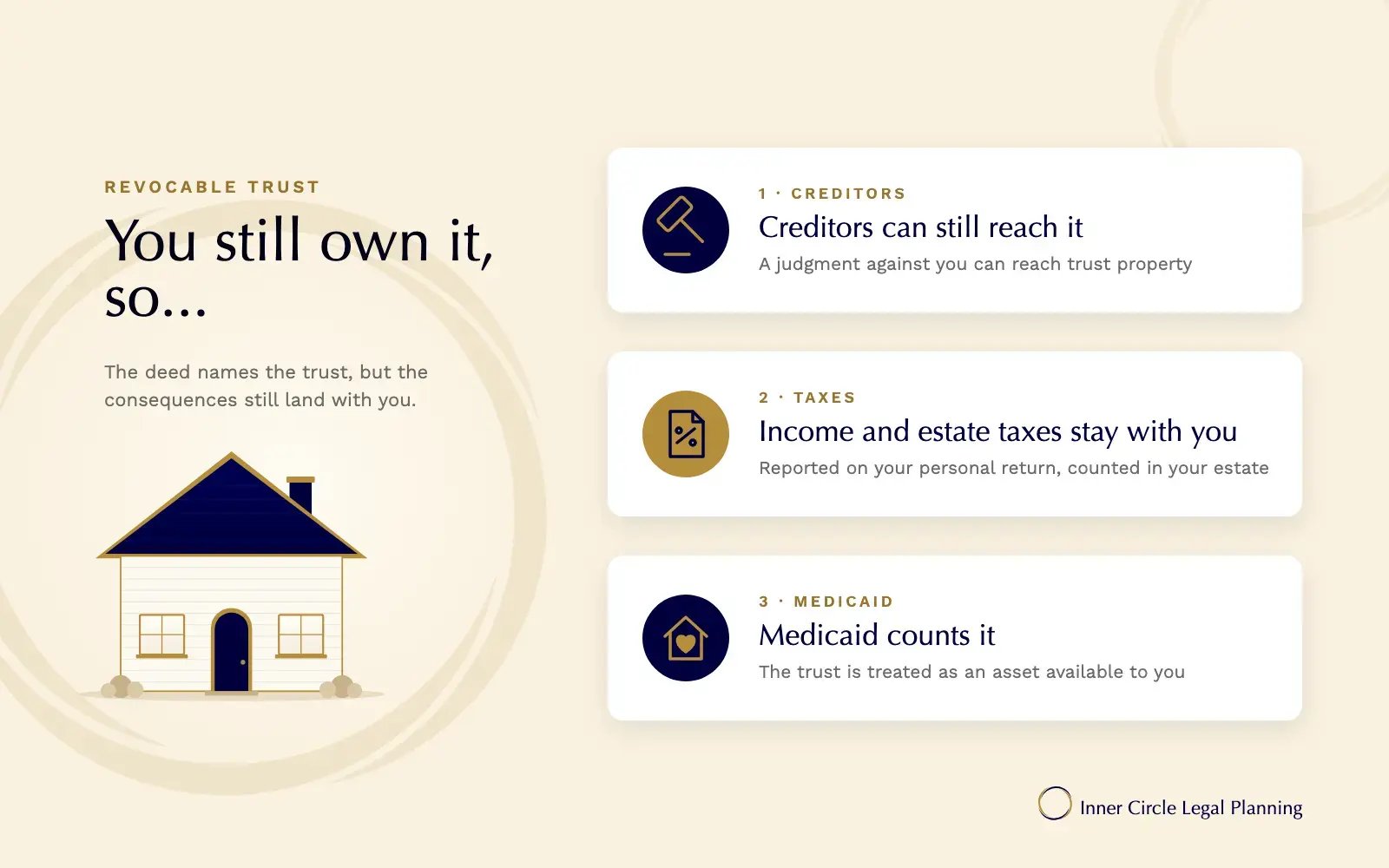
Because you still own property in a revocable trust, three consequences follow.
Your Creditors Can Still Reach Trust Property
Because the property is still yours, a judgment against you can reach it. A revocable trust is a probate and incapacity tool. It is not an asset protection tool, and if anyone sold it to you as one, you were misled.
If protecting assets from future claims is the goal, that is a different conversation. Our asset protection attorney page explains what actually does that job.
Income and Estate Taxes Stay With You
The IRS treats it the same way. According to the IRS instructions for Form 1041, a revocable living trust is treated as a grantor type trust for tax purposes. In practice:
- Trust income is reported on your personal return, just as it was before.
- Most people can use the IRS's simplest reporting method, giving banks and other payers your own name and Social Security number instead of filing a separate trust return.
- The assets stay in your taxable estate. Federal law includes in your estate any property you transferred subject to a power to revoke.
Does a Revocable Trust Protect Assets From Medicaid?
No. This is the costliest misunderstanding in the whole topic.
Federal Medicaid law says that for a revocable trust, the corpus of the trust shall be considered resources available to the person who created it. Connecticut applies that rule. In Romanelli v. Department of Social Services, a couple had placed two properties in a revocable trust, and Medicaid was denied because the trust was treated as an available asset.
What actually protects a home from long-term care costs is a properly structured irrevocable trust, set up well in advance. Our Medicaid asset protection trust page explains how that works and how the timing rules apply.
How Title Reads on a Connecticut Deed
When you put your home into a revocable trust, you sign a new deed from yourself, as an individual, to yourself as trustee. The grantee line typically reads something like:
Jane A. Smith, Trustee of the Jane A. Smith Revocable Trust dated March 4, 2025
Notice what is named: the trustee, the trust and the date it was signed. Like any Connecticut conveyance, the deed must be in writing, signed, acknowledged and witnessed by two people. The word "trustee" after your name does not, on its own, limit your right to sell or mortgage the property later.
The deed is then recorded in the land records of the town where the property sits. Under Connecticut law, a conveyance is not effective against anyone but the grantor and their heirs unless it is recorded in that town's records.
The most common failure we see: the trust exists on paper, but the deed was never signed or recorded. The house never went in, so nothing the trust says about it applies. If you are not sure whether your deed was recorded, a quick check with your town clerk will tell you, and our guide on how to fund a revocable trust covers the rest.
What Happens to Ownership When the Grantor Dies
At your death, the trust becomes irrevocable and your successor trustee takes over. Ownership then passes under the trust's terms rather than through probate. That is the benefit you were actually buying.
Connecticut gives the successor trustee 60 days to notify the beneficiaries that the trust has become irrevocable. From there, a trust administration attorney can guide your family through retitling, distributions and everything that comes next.
Frequently Asked Questions
Know Exactly What You Already Have
If you have a revocable trust, you have not lost your home. You have simply organized it so your family is not stuck in probate later. Understanding what still belongs to you, and what the trust can and cannot do, is what turns a stack of signed documents into real peace of mind.
If you would like a second set of eyes on your trust or your deed, we are happy to walk through it with you, in plain English and without pressure.